
Call us:
866-923-2712
A question Ravenna families know how to ask carefully — and why asking it early matters more than getting it right.
Ravenna has always been a neighborhood for people who pay attention. The kind of attention that names every tree on the boulevard, notices when the Cloud City coffee order has changed, keeps track of who is walking their dog at what hour. It’s a community of readers, walkers, gardeners, and people who have lived on the same block long enough to know its rhythms by heart.
Which is exactly why early memory changes can be so easy to miss here.
Familiar surroundings are the brain’s best compensation strategy. When the streets, the routes, the routines, and the faces are all deeply known, the brain can navigate on autopilot while something more significant is quietly shifting. It isn’t until the familiar becomes uncertain — the walk through Ravenna Park that ends in confusion, the coffee order forgotten, the story told three times in an afternoon — that families begin to wonder whether something has changed.
|
Something Worth Knowing Early — About Life’s Neighborhood™ at Aegis Living Ravenna Before we get into what the signs are and what to watch for, here is something families often tell us they wish they’d known sooner:
Memory Care does not have to be a last resort. And knowing what a good Memory Care environment looks and feels like — long before you need it — changes the decisions you make along the way.
Aegis Living Ravenna was designed around the Italian philosophy of la dolce vita — the sweet life. Warm terracotta, arched doorways, mosaic accents, sunlit courtyards opening onto Maple Leaf Reservoir Park. The community is inspired by the Ravenna Opera House and the Roman Holiday spirit its founder brought back from decades of loving that part of the world.
Life’s Neighborhood, the dedicated Memory Care program, carries that same warmth. It doesn’t feel institutional. It feels the way a gracious, sunlit Italian courtyard feels: settled, unhurried, and safe. The garden access to the park — the trees, the birdsong, the particular quality of northeast Seattle light — is not an amenity. It is part of the care.
Dementia-trained caregivers are present 24 hours a day, seven days a week. |
Normal aging affects memory, but it doesn’t disrupt life. Most people slow down a little. Words take longer to come. A name has to be searched for. These are expected and medically supported features of a healthy aging brain.
What clinicians look for — across neurologists, geriatricians, and the Alzheimer’s Association — is change that creates friction. Not forgotten names, but missed bill payments. Not slower word retrieval, but getting lost on a familiar route. Not needing a reminder, but needing someone to quietly step in and manage something that was always handled independently.
That friction — in daily function, in financial management, in navigation, in the ability to follow multi-step tasks — is what distinguishes normal aging from early cognitive decline. And it tends to appear well before anyone in the family is ready to name it.
|
The Signal Most Families Miss First Mood and behavioral changes — new anxiety, irritability without clear cause, withdrawal from social settings that were once enjoyed — often appear before significant memory loss. They are neurological signals, not personality shifts. Specialists treat them as early indicators worth tracking. |
There is also the matter of self-awareness. One of the earliest and most clinically significant signs of cognitive change is a reduced ability to recognize that anything is wrong. A brain that no longer accurately monitors itself tends to minimize errors, resist gentle correction, and insist that nothing has changed — not from stubbornness, but because the monitoring system itself is affected. This is one of the clearest signals clinicians use to recommend earlier evaluation.
In Ravenna, Bryant, and Green Lake — neighborhoods where people have been neighbors for decades — the social fabric itself does a great deal of compensating. A spouse who starts doing more driving without explaining why. A daughter who quietly takes over the bills. A friend who walks alongside and gently redirects when the route goes wrong.
These adjustments are loving. They are also, typically, the first functional sign that something worth evaluating is underway. Clinicians call it covering — and when families realize they’ve been doing it for months without naming it, that is itself meaningful information.
|
A Simple Way to Track What You’re Seeing A running log — phone notes, a notebook, anything — that records what task broke down, how often, and whether it’s getting harder to manage is more useful to a clinician than any single incident. Thirty to sixty days of pattern documentation is genuinely actionable. |
Falls feel like a physical concern. Clinicians know they are often a cognitive one. The same brain processes that govern memory also govern spatial awareness, reaction time, balance during transitions, and the ability to divide attention. When the brain is working harder than usual to keep up with daily demands, the body’s capacity to respond to the unexpected decreases quietly alongside it. The near-fall on familiar stairs. The hesitation rising from a chair. These are early signals worth paying attention to, not incidents to brush off.
At Aegis Living Ravenna —adjacent to Maple Leaf Reservoir Park — we use AUGi™, an AI-powered fall-prevention system that tracks movement patterns without cameras or video. It surfaces early changes in gait, hesitation, and nighttime movement that families rarely see at home — allowing care teams to respond quietly, before something happens.
If you’re noticing patterns in someone you love and wondering whether they’re significant: they probably deserve attention. Not panic. Not a diagnosis. Just attention, documentation, and — when you’re ready — a conversation. UW Medical Center is minutes away for evaluation. And Aegis Living Ravenna is always available for a no-pressure call.
Download Our Memory Care Guide — Free
Next: Mild Cognitive Impairment — what the diagnosis actually means, why the window it opens matters, and what the right environment can do during it.
Mild Cognitive Impairment is not a waiting room. It’s a window — and the environment matters enormously during it.
“Monitor it” is the most common advice given after a Mild Cognitive Impairment diagnosis. It makes clinical sense: not everyone with MCI progresses to dementia, progression is variable, and there’s no single treatment that changes the course.
What the advice doesn’t fully convey is who does the monitoring.
Usually, it’s the family. And what they’re monitoring is a person they love who knows something has changed, carries the anxiety of not knowing what it means, and is simultaneously trying to maintain an independent life that now requires more effort than it used to.
MCI is described clinically as a stage between normal aging and dementia — measurable cognitive decline without significant loss of independence. Families experience it as something more specific: constant mental math. Watching for what’s new. Second-guessing when to step in. Managing the guilt of both stepping in too early and not stepping in soon enough.
|
What “Cognitive Load” Means in Practice MCI is less about memory failure and more about cognitive strain — the brain working significantly harder than it used to just to keep up. That strain appears in fatigue, in slower decision-making, in reduced tolerance for complexity and noise. The independence is largely intact, but it costs more than it used to. |
The MCI brain is still adaptive. It still responds to calm, to consistency, to the presence of things that feel familiar and safe. What research has increasingly confirmed is that the right environment during MCI can genuinely slow progression — not through medication or intensive intervention, but by reducing the cognitive and emotional load the brain is carrying every day.
Stress accelerates cognitive decline. Environments that reduce stress — predictable rhythm, managed sensory input, genuine warmth, access to nature — can meaningfully affect trajectory. The window for this kind of support is real. And it is not infinite.
|
Life’s Neighborhood™: Why Beautiful Environments Are Clinical Tools The Italian philosophy behind Aegis Living Ravenna is not simply aesthetic. La dolce vita — the sweet life — is a conviction about what makes human beings thrive: beauty, warmth, good food, generous company, and the ease of a life that isn’t harder than it needs to be.
For someone navigating MCI, that philosophy is clinical.
The warm terracotta, the arched doorways, the sunlit courtyards opening onto Maple Leaf Reservoir Park: these are not decorative choices. They are an environment designed to reduce cognitive load — to create a place the brain can move through without constantly being asked to orient, interpret, or manage. A beautiful, settled, gracious environment stops generating unnecessary demands on a brain that is already working hard.
Life’s Neighborhood at Aegis Living Ravenna supports residents across the full spectrum of cognitive change, including people at the MCI stage who are still largely independent. The outdoor access to the park — trees, green space, birdsong, open sky — is offered as a daily resource, not a scheduled activity. Nature consistently reduces the anxiety that MCI makes harder to manage.
This is the right stage to know what this looks like. Dementia-trained caregivers are present 24 hours a day. |
Falls don’t begin with advanced dementia. They begin here — during MCI — because cognition governs balance, reaction time, spatial awareness, and divided attention. When the brain is under higher-than-usual cognitive load, the body has less capacity to respond to the unexpected. A moment’s distraction during a transition. A hesitation coming down a familiar flight of stairs. These are functional signals, not accidents.
AUGi™ at Aegis Living Ravenna monitors movement patterns quietly — tracking changes in gait, hesitation, and nighttime movement without cameras or video — and surfaces early risk signals before they become incidents. It gives care teams the early information they need to adjust support quietly, in ways that preserve rather than restrict independence.
They are not usually calling because they’ve made a decision. They’re calling because they’re exhausted from the uncertainty and they want to understand their options while they still have room to choose thoughtfully. That is exactly the right instinct.
A tour of Aegis Living Ravenna at the MCI stage is different from one made in a crisis. There is time to sit in the courtyard, meet the team, understand what the daily rhythm looks and feels like, and ask questions without urgency pressing in from every side.
We’re at 8511 15th Avenue NE — adjacent to Maple Leaf Reservoir Park, minutes from Green Lake and the University District. A conversation doesn’t commit you to anything. It gives you something better: clarity.


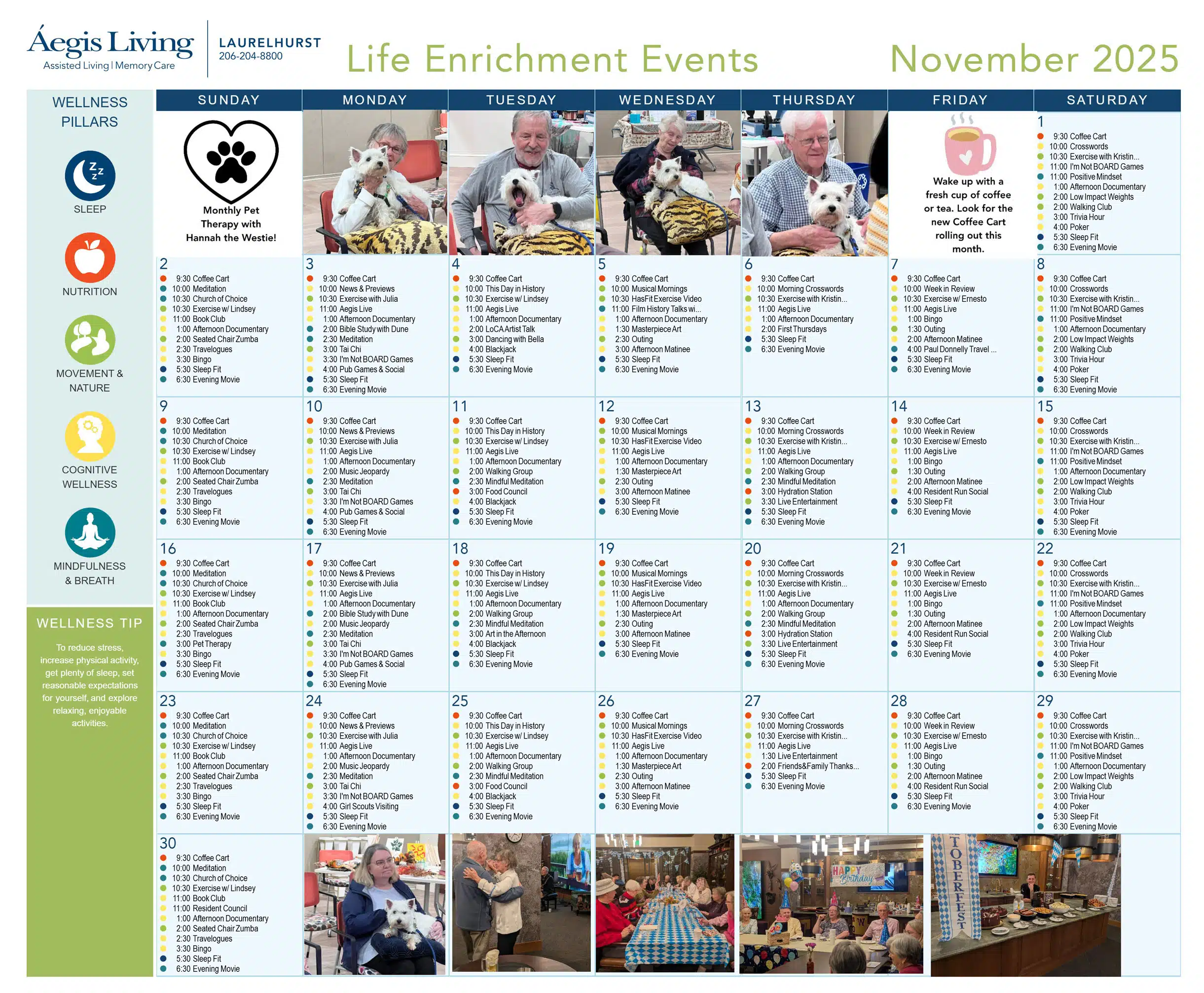
Respite Stays & Day Stays give family caregivers a real break—hours, days, or a few weeks—while your loved one enjoys a safe, enriching short‑term home at Aegis Living. Guests settle into a beautifully furnished private apartment and have 24/7 care staff and onsite nurses, medication management, and discreet safety technology (motion sensors, medical‑alert pendants, visitor check‑in) for peace of mind. Each day feels purposeful with chef‑prepared, all‑day dining and 200+ monthly activities—from book clubs and fitness classes to movie nights—plus full use of the community. We coordinate with your loved one’s physicians to mirror their routines and care, so the stay feels familiar. It’s also a smart trial run for senior living: meet neighbors, test services, and see what supported independence looks like—without a long‑term commitment. Choose a Respite Stay when you’re traveling or need time to recharge, when your loved one would benefit from structure, social connection, and great meals, or when you both want peace of mind while keeping options open.
Hospice & End‑of‑Life Care at Aegis Living is comfort‑first support for the final stage of life, delivered in your loved one’s private apartment by our 24/7 care team in coordination with a trusted local hospice provider you choose (or we can recommend). Together, we create a coordinated care plan that manages pain and other symptoms, oversees medications, and provides calm, dignified help with daily needs, while offering compassionate emotional support for both resident and family. Discreet safety measures and a reliable medical‑alert system bring help quickly; chef‑prepared, in‑apartment meals adapt to changing appetites. Families are guided through decisions and moments of closure so they can focus on being present in a peaceful, home‑like setting. If your loved one already lives at Aegis, they can remain in the comfort of their home, avoiding disruptive moves. Choose this level of care when curative treatment is no longer the goal and you want expert symptom control, hands‑on daily support, and a setting that protects dignity and prioritizes comfort, meaning, and time together.
Memory Care is specialized, secure support for people living with Alzheimer’s or other dementias who benefit from a calm, structured environment and round‑the‑clock expertise. At Aegis Living, that care happens in Life’s Neighborhood—an intimate, thoughtfully designed setting where 24/7 dementia‑trained caregivers and a nursing team on site seven days a week deliver personalized help with daily living, medication management, and mobility (including Hoyer lifts and two‑person transfers), while gently redirecting agitation and confusion. Days are purpose‑filled with science‑based cognitive programming, certified music therapy, and social activities; chef‑prepared meals are easy to enjoy and dining spaces and cues are designed for memory support. Discreet safety features like secured entrances, emergency pendants with fall detection, and optional motion sensors, prevent wandering and bring peace of mind, and visiting physicians and wellness professionals reduce trips off‑site. Families receive education and ongoing support. If your loved one is unsafe alone, missing medications, wandering, needs frequent cueing or hands‑on help with bathing or dressing, or thrives with a predictable routine, Memory Care offers the right level of care. For milder needs, our transitional Assisted Living can be a first step; for advancing symptoms, secured Memory Care provides the specialized, heartfelt support to help them feel calm, connected, and at home.