
Call us:
866-923-2712
This is the stage when Laurelhurst families feel stuck — and the right environment can quietly make a significant difference.
The conversation usually starts a few weeks after a doctor’s appointment. Not with urgency. With uncertainty.
“They said it’s Mild Cognitive Impairment.”
“They told us to monitor it.”
“We’re not really sure what that means.”
The person they love is still walking to University Village for coffee, still making it to the neighborhood book club, still largely independent. And that word — mostly — is what keeps Laurelhurst families frozen in place.
Clinically, Mild Cognitive Impairment sits between normal aging and dementia. Neurologists describe it as a measurable cognitive decline that doesn’t yet significantly interfere with daily independence.
Families don’t experience it that way. They experience it as constant mental calculation: Is this normal? Is this new? Should I step in or step back?
According to geriatric specialists and organizations like the Alzheimer’s Association, MCI is less about memory and more about cognitive load — how hard the brain is working just to keep up. That strain appears well before independence is lost.
It’s rarely one dramatic incident. It’s an accumulation. Tasks take longer. Decision-making feels heavier. Fatigue sets in earlier each day. And often, families notice something harder to name: their loved one seems less steady when managing two things at once — walking while talking, navigating a busy event at UW, keeping track of a complex conversation the way they always used to.
This isn’t a failure of intellect. It’s cognitive strain showing up in the body and in daily life — and it’s a signal worth taking seriously.
|
AUGi™ AI-Powered Fall Prevention Technology At Aegis Living Laurelhurst, we use AUGi™, an AI-powered fall-prevention system, to identify subtle changes in movement that families and even caregivers may miss.
AUGi™ detects patterns such as hesitation when standing, changes in gait, increased nighttime movement, and restlessness during transitions.
This allows care teams to adjust support before a fall occurs, increase supervision at the right moments, and preserve independence without unnecessary restriction.
Seeing Cognitive Strain Before It Becomes a Safety Issue
In the early stages of cognitive change, the brain often exerts greater effort to complete everyday tasks — long before independence is lost. At Aegis Living Laurelhurst, AUGi™ helps care teams recognize when that strain begins to affect how someone moves, even subtly.
By identifying these changes early, care teams can reduce cognitive and physical load before stress escalates, adjust routines and support timing, and help residents maintain confidence and independence longer. |
|
Life’s Neighborhood™: The Right Environment at the Right Time At the MCI stage, the environment a person lives in matters more than most families realize. The brain is still responsive — to calm, to routine, to the comfort of the familiar. What surrounds a person shapes how the stage unfolds.
Life’s Neighborhood at Aegis Living Laurelhurst is designed around what a changing brain actually needs: predictable rhythms, a warm and unhurried pace, and sensory anchors that feel safe rather than demanding.
The Memory Care outdoor terrace draws on one of the most universal sources of comfort for Pacific Northwest residents — the Apple Cup. The friendly rivalry between the Huskies and the Cougars has marked Washington autumns for generations. Whether someone bled purple and gold or crimson and gray, those memories — the excitement, the belonging, the friendly arguments among family and neighbors — live deep in the long-term emotional memory that remains accessible even when recent recall has started to fade.
That is the heart of reminiscence-based care: reaching the feelings that are still there, even when the words for them are harder to find. |
Because independence remains largely intact, families compensate. They remind. They organize. They quietly step in. For a while, this works.
But most specialists now agree that during MCI, waiting often increases stress rather than improving safety. Anxiety rises, confidence drops, and fall risk quietly increases — not because someone is fragile, but because the brain has less margin for the unexpected. This is why many clinicians now view MCI as the stage where early environmental support can have the greatest impact with the least disruption.
Falls are often associated with later-stage dementia, but clinicians know they begin much earlier. Cognition affects reaction time, judgment during transitions, spatial awareness, and the ability to manage multiple inputs while moving. When the brain is working harder to process information, the body has less room for error. Falls are a functional signal, not just a safety concern.
At Aegis Living Laurelhurst, AUGi™ functions as a quiet, continuous observer. It detects subtle changes in movement and routine that families often can’t see at home — slight hesitation when standing, changes in gait consistency, increased nighttime movement, and restlessness during transitions.
Nothing changes for the resident. AUGi™ never records or displays video; residents appear only as abstract movement figures, with apartment details blurred. Alerts are shared only with authorized care team members. What care teams gain is early insight — allowing them to make minor adjustments before confidence or safety is affected.
At the MCI stage, families don’t need certainty. They need traction. This week, focus on:
If these changes help, that’s meaningful. If they don’t, it often signals that additional environmental support is needed — and that’s information, not failure.
Most families don’t reach out because they’re ready to make a move. They reach out because they’re tired of second-guessing themselves. A brief conversation at this stage can save months of uncertainty.
If you’re navigating MCI and wondering what support can look like now — rather than later — a conversation can bring clarity without forcing a decision. You’re welcome to visit Aegis Living Laurelhurst at 3200 NE 45th Street for a relaxed, no-pressure tour — steps from the Burke-Gilman Trail and just minutes from the heart of the UW campus.


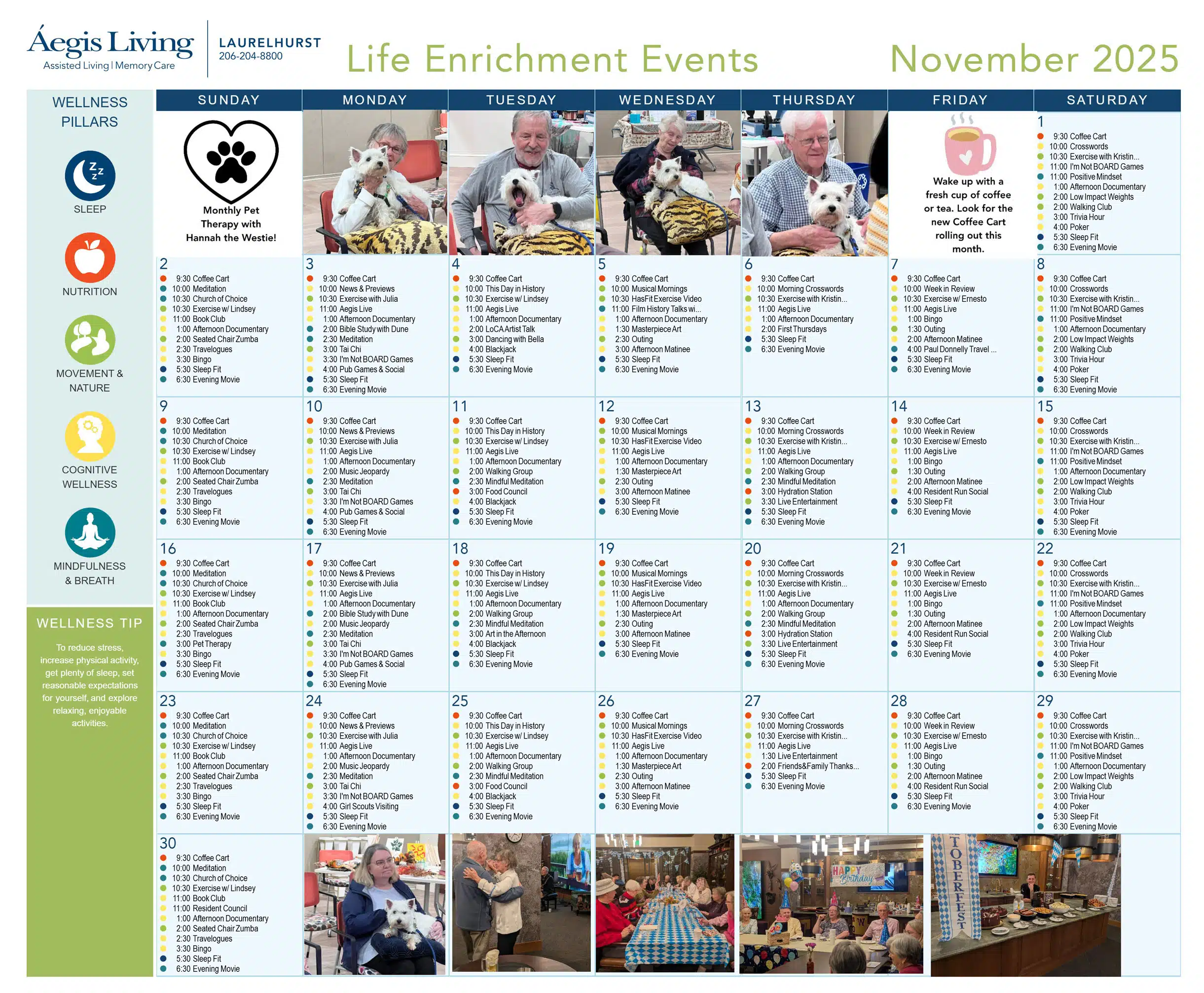
Respite Stays & Day Stays give family caregivers a real break—hours, days, or a few weeks—while your loved one enjoys a safe, enriching short‑term home at Aegis Living. Guests settle into a beautifully furnished private apartment and have 24/7 care staff and onsite nurses, medication management, and discreet safety technology (motion sensors, medical‑alert pendants, visitor check‑in) for peace of mind. Each day feels purposeful with chef‑prepared, all‑day dining and 200+ monthly activities—from book clubs and fitness classes to movie nights—plus full use of the community. We coordinate with your loved one’s physicians to mirror their routines and care, so the stay feels familiar. It’s also a smart trial run for senior living: meet neighbors, test services, and see what supported independence looks like—without a long‑term commitment. Choose a Respite Stay when you’re traveling or need time to recharge, when your loved one would benefit from structure, social connection, and great meals, or when you both want peace of mind while keeping options open.
Hospice & End‑of‑Life Care at Aegis Living is comfort‑first support for the final stage of life, delivered in your loved one’s private apartment by our 24/7 care team in coordination with a trusted local hospice provider you choose (or we can recommend). Together, we create a coordinated care plan that manages pain and other symptoms, oversees medications, and provides calm, dignified help with daily needs, while offering compassionate emotional support for both resident and family. Discreet safety measures and a reliable medical‑alert system bring help quickly; chef‑prepared, in‑apartment meals adapt to changing appetites. Families are guided through decisions and moments of closure so they can focus on being present in a peaceful, home‑like setting. If your loved one already lives at Aegis, they can remain in the comfort of their home, avoiding disruptive moves. Choose this level of care when curative treatment is no longer the goal and you want expert symptom control, hands‑on daily support, and a setting that protects dignity and prioritizes comfort, meaning, and time together.
Memory Care is specialized, secure support for people living with Alzheimer’s or other dementias who benefit from a calm, structured environment and round‑the‑clock expertise. At Aegis Living, that care happens in Life’s Neighborhood—an intimate, thoughtfully designed setting where 24/7 dementia‑trained caregivers and a nursing team on site seven days a week deliver personalized help with daily living, medication management, and mobility (including Hoyer lifts and two‑person transfers), while gently redirecting agitation and confusion. Days are purpose‑filled with science‑based cognitive programming, certified music therapy, and social activities; chef‑prepared meals are easy to enjoy and dining spaces and cues are designed for memory support. Discreet safety features like secured entrances, emergency pendants with fall detection, and optional motion sensors, prevent wandering and bring peace of mind, and visiting physicians and wellness professionals reduce trips off‑site. Families receive education and ongoing support. If your loved one is unsafe alone, missing medications, wandering, needs frequent cueing or hands‑on help with bathing or dressing, or thrives with a predictable routine, Memory Care offers the right level of care. For milder needs, our transitional Assisted Living can be a first step; for advancing symptoms, secured Memory Care provides the specialized, heartfelt support to help them feel calm, connected, and at home.