

Why Asking for Help Is One of the Most Loving Things You Can Do
For the family member who keeps saying "we're managing" — and is starting to wonder if that's still true.
There is a particular kind of stress that comes from loving someone who needs more help than you can give. You rearrange your schedule. You check in more often. You tell yourself things are fine, or at least fine enough. And then something happens — a fall, a wandering incident, a missed medication, a moment where you realize that what you've been managing alone has grown beyond what any one person should be expected to manage alone.
If you are in that place right now, this is for you.
At Callahan House (Memory Care) and Áegis Living Shoreline (Assisted Living), we have assisted hundreds of Shoreline-area families navigating exactly this kind of moment. What we've learned is this: the families who reach out earlier — before a crisis forces the decision — have more options, more time, and far less heartbreak.
This guide is designed to help you recognize the signs, understand what different levels of care actually look like, and feel confident taking that first step.
The Numbers Behind What Families Are Feeling
If it feels like more families around you are facing these questions, that's because they are. The scale of what's happening with aging in America is significant, and it has very real consequences for families.
- 1 in 4Older adults fall each year. Falling once doubles the chance of falling again — and fewer than half tell their doctor.
CDC
- 7.2MAmericans living with Alzheimer's disease — the first time the number has exceeded 7 million.
Alzheimer's Association, 2025
- 38MUnpaid family caregivers, averaging nearly 4 hours of care per day. Nearly 30% provide 30+ hours a week.
- 2 in 3Dementia caregivers say finding resources and support for themselves is difficult.
Alzheimer's Association
Sources: CDC Older Adult Fall Prevention Data (2024); Alzheimer's Association 2025 Facts & Figures; U.S. Bureau of Labor Statistics / Seniorly Caregiver Report (2024); A Place for Mom Caregiver Burnout Statistics (2026)
“The families who ask for guidance earliest almost always tell us they wish they'd reached out sooner. Not because they did anything wrong — but because the right support changed everything.”
Clarissa FittingMarketing Director at Áegis Living Shoreline
Signs It May Be Time for More Support
These signs don't arrive all at once. Usually they accumulate gradually, until the picture becomes undeniable. You may recognize several of these already.
Safety at Home Is Becoming Harder to Maintain
- The quiet warning signs before a fall
- Holding onto walls or furniture while walking, shuffling or a slower gait, trouble getting up from a chair or bed, unexplained bruising, or a growing fear of stairs and showers. These are the body's early warnings — and worth taking seriously.
- Repeated falls or near-falls
- A single fall is a warning sign; multiple falls are a pattern. A hospitalization after a fall is one of the most common turning points families describe — and when having already explored options makes an enormous difference.
- Wandering or disorientation
- Getting lost in familiar places — the local grocery store or their own neighborhood — is one of the clearest signs memory care may be needed. This is one of the leading reasons families contact Callahan House.
- Nighttime confusion and sundowning
- Increasing agitation, anxiety, or disorientation in the late afternoon or evening can be one of the most exhausting experiences caregivers describe — and a clear sign memory care may be the right support.
- Kitchen and appliance incidents
- Burned pots, forgotten burners, confusion about how to use familiar appliances — often the first concrete safety signals families notice.
- Driving concerns
- Getting lost on familiar routes, unexplained dents or scrapes on the car, or a family member expressing anxiety about driving are all meaningful signals.
Daily Life Is Becoming Difficult to Manage
- Medication problems
- Missing doses, doubling up, or being unable to manage a pill organizer without daily intervention. Medication mismanagement is one of the top reasons older adults end up in emergency rooms.
- Declining hygiene or nutrition
- Skipping showers, wearing the same clothes for days, losing weight, or forgetting to eat — signs that basic self-care has become too difficult to manage independently.
- Trouble with finances or mail
- Unopened bills, confusion about accounts, falling victim to scams, or forgetting to pay utilities are early signs of cognitive decline families often overlook.
- Withdrawing from things they love
- When someone stops participating in hobbies, social activities, or relationships, isolation often follows — and isolation accelerates both cognitive and physical decline.
The Caregiver Is Struggling
This sign is just as important as any other on this list, and it is the most frequently overlooked.
- Caregiver burnout is real and measurable
- Research in the Journals of Gerontology identifies “tipping points” where caregiving intensity correlates directly with deteriorating psychological health. Nearly 30% of caregivers provide 30+ hours of care per week, often while holding jobs.
- Caregiver health suffers too
- Caregivers experience higher rates of depression, anxiety, compromised immune function, and delayed medical care for themselves. You cannot pour from an empty cup — and the person you love needs you to be well.
- You are afraid of what might happen
- If you lie awake worrying, check on your loved one in the middle of the night, or are afraid to leave them alone for even a few hours, that fear is a message worth listening to.
“Caregiving is an act of love. But so is recognizing when the level of care someone needs has grown beyond what one person can safely provide.”
Lindsay OliverMarketing Director at Callahan House
Assisted Living vs. Memory Care
One of the most common points of confusion is knowing when assisted living is the right fit versus when memory care is needed. Here's a plain-language guide.
- Assisted Living — Áegis Living Shoreline
For older adults who need support with daily activities — bathing, dressing, medications, meals — but who can still engage meaningfully with their environment and community.
The right fit for someone who:
- Needs help with daily tasks but wants to keep as much independence as possible
- Would benefit from consistent meals, medication management, and a structured day
- Is socially oriented and would thrive in a community environment
- Has early-stage cognitive changes but doesn't yet require a secured environment
- Memory Care — Callahan House
A specialized level of care for individuals living with Alzheimer's or other dementias. It's not assisted living with more staff — it's a fundamentally different, purpose-built environment.
The right fit for someone who:
- Has been diagnosed with Alzheimer's or another form of dementia
- Has begun wandering or becoming disoriented in familiar settings
- Needs a secured environment for their safety
- Requires care specifically trained in dementia and memory loss
- Would benefit from programming designed around their cognitive needs
The decision between the two — or the transition from one to the other — is something we help families navigate directly. There is no judgment in that conversation, only honest guidance.
What Families Wish They'd Known Sooner
- A professional assessment early opens more doors, not fewer
- Reaching out before a crisis gives you time to tour communities, ask questions, get on waitlists, and make a thoughtful decision rather than a rushed one.
- The transition is often harder for the family than the resident
- Many are surprised to find their loved one settles in more quickly than expected — because the right environment removes the daily struggle that had been wearing them down.
- Life here is full of connection, joy, and purpose
- Residents have relationships, routines, and days filled with real meaning. The goal is always quality of life, not just safety.
- 24–48 hour move-in is possible when it's needed
- After a hospitalization, fall, or crisis at home, we can help facilitate a rapid transition. You don't have to navigate that alone.
- You are allowed to need help too
- The caregiver's wellbeing is not secondary. It is part of the equation.
We Are Right Here in Shoreline
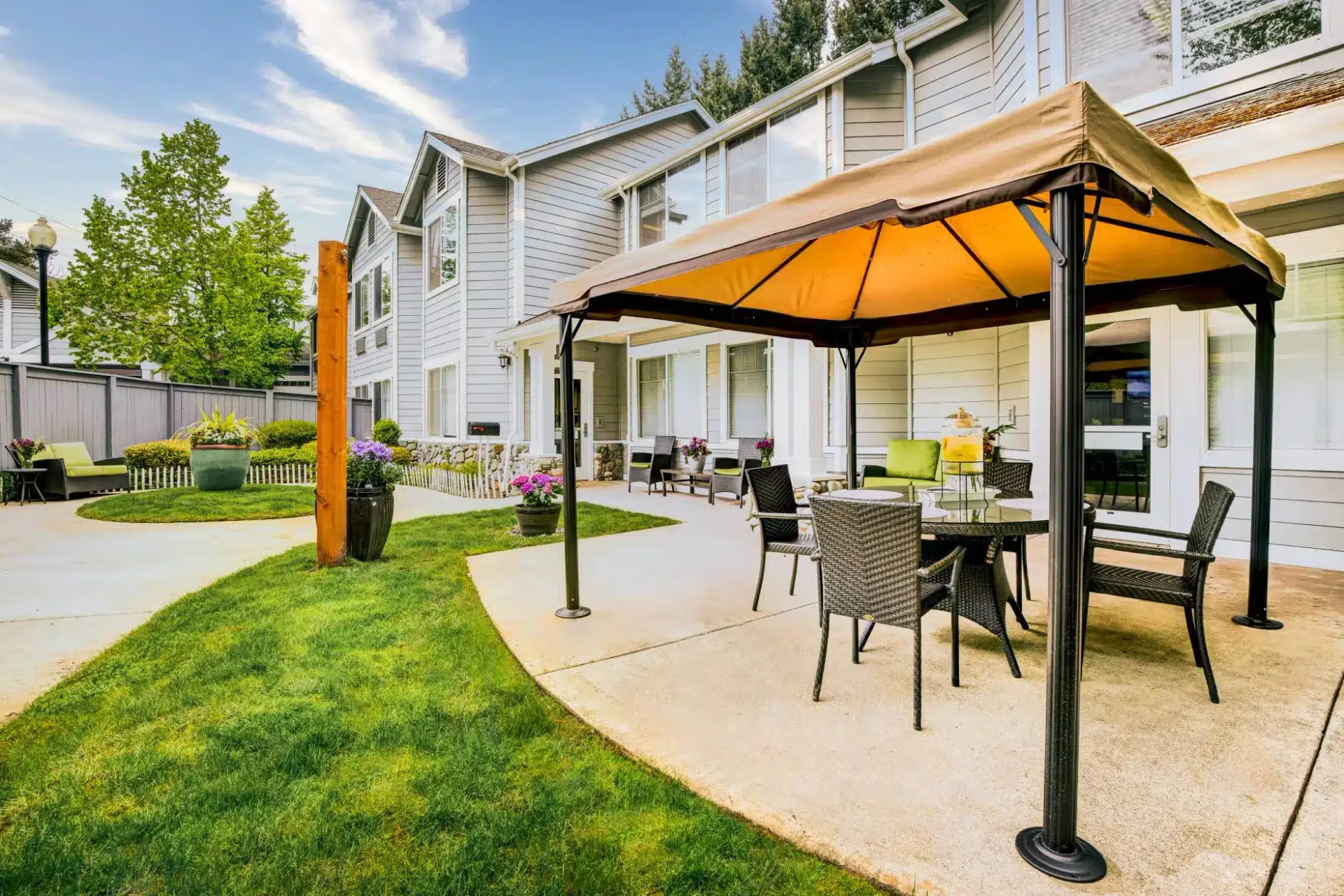
We are Clarissa and Lindsay, the marketing directors for Callahan House (Memory Care) and Áegis Living Shoreline (Assisted Living). Our communities sit next to each other and make up one campus to cover all your senior living needs. We are not a national call center — we are local people, embedded in this community, who have helped Shoreline families through some of the most difficult and most important decisions of their lives.
When you reach out to us, here is what you will find:
- No sales pressure
- We will listen first — about your situation, your loved one, and what you're seeing. We will not push you toward a decision you're not ready for.
- Honest guidance
- If Callahan House or Áegis Living Shoreline isn't the right fit, we will tell you. Our goal is to connect people with the right level of care.
- A real visit
- We'll show you around, introduce you to the team, and let you ask every question — no matter how big or small.
- Support at every step
- From the first phone call through move-in day and beyond, we are here.
You don't have to have all the answers before you reach out. You don't have to be in crisis. You just have to be someone who loves a person and wants to understand their options.
Reach Us Directly
That's enough. We'll take it from there.
Come see the campus in Shoreline
Schedule a visit to Áegis Living Shoreline or Callahan House — we'll show you around, introduce you to the team, and answer every question.